.png)
Beyond traction: a comprehensive guide to advanced spinal decompression therapy for 2025


Advanced, computerized spinal decompression is a targeted, non-surgical treatment for specific conditions like herniated discs and sciatica, offering a significant upgrade over simple traction when conservative care has failed. The true question isn't whether it works, but whether your specific diagnosis and history make you an ideal candidate for this precise, modern back pain relief method.
The decompression decision point: when standard back pain treatments aren't enough
If you're reading this, chances are you've already walked a long and frustrating road with your back pain. You've likely tried rest, medication, chiropractic adjustments, and physical therapy. While these methods are essential first steps, for many, they provide only temporary relief. You reach a point—what we call the "decompression decision point"—where the pain persists, interfering with your life, work, and well-being. This is precisely the scenario where exploring more advanced therapeutic modalities becomes crucial. Decompression therapy is often a viable treatment option when other conservative treatments haven't provided the long-term relief you need according to healthcare experts.
The pain from compressed nerves in the spine, whether it's a sharp sciatic shock down your leg or a persistent ache from degenerative disc disease, originates from a structural problem. Often, the issue is excessive pressure on your vertebral discs. It has been observed that intervertebral disc issues are responsible for more than 80% of cases presenting with low back pain establishing a common cause that modern therapies aim to treat. When the pressure becomes too great, discs can bulge or herniate, pinching the delicate nerves that exit the spinal column. The goal of any effective, long-term solution must be to relieve that pressure.
Not all spinal traction is created equal: the critical difference
For decades, the primary method for relieving this pressure was traction. However, the term "traction" is a broad one that needs clarification. Traditional mechanical traction involves a steady, linear pull on the spine. While the concept is sound, the body's natural response is often to resist this pull through muscle guarding and spasms, limiting the therapy's effectiveness at the specific disc level.
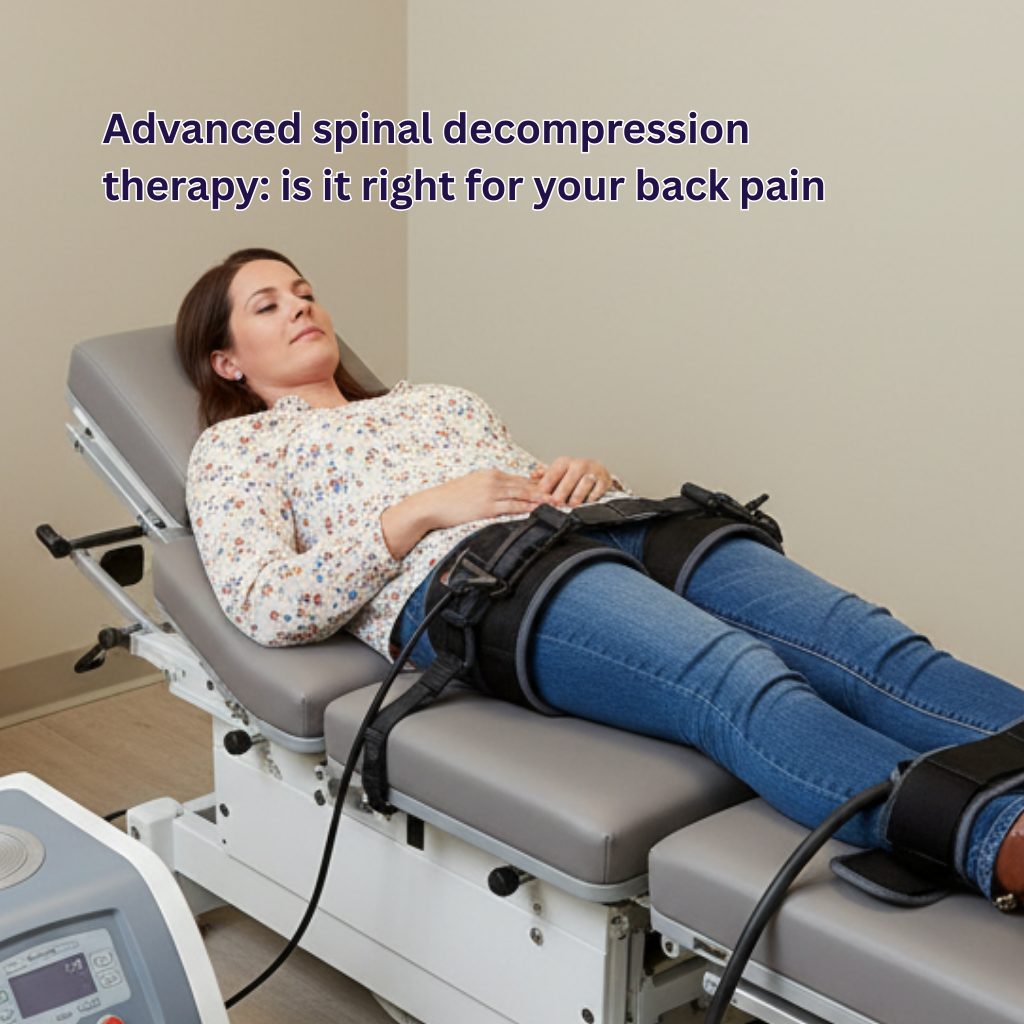
This is where advanced spinal decompression therapy represents a paradigm shift. This is not the same as using an inversion table or a basic mechanical traction table. Advanced systems, like the DRX9000, are computerized and use sophisticated algorithms to apply a precise, angled, and oscillating force. This intelligent approach allows the therapy to bypass the body's guarding reflex and target the exact spinal segment that needs care.
Here’s how a modern decompression machine functions:
- Segmental Targeting: The system isolates the specific lumbar or cervical level (e.g., L4-L5) causing your pain.
- Logarithmic Pulling: Instead of a static pull, the table gently and slowly applies and releases tension in a calculated rhythm.
- Creating Negative Intradiscal Pressure: This gentle distraction creates a vacuum effect, or "negative intradiscal pressure," inside the targeted disc. This is the key to healing. This vacuum can help draw the bulging or herniated material back into the center of the disc and away from the pinched nerve root.
- Promoting Disc Rehydration: The negative pressure also encourages the flow of water, oxygen, and nutrients into the disc, which is vital for spinal decompression and disc rehydration and the long-term health of the spine.
The difference is not trivial. In a study comparing treatments for herniated discs, the herniation index in the group receiving advanced decompression therapy decreased significantly compared to the group receiving conventional traction therapy according to research published in the PMC. This highlights why understanding the technology you're receiving is critical to your outcome.
The nuanced comparison: decompression vs. traction vs. surgery
When considering alternatives to back surgery for a herniated disc, it's essential to weigh your options. Here is a breakdown of the three primary paths for patients who haven't found relief from initial conservative care.
Advanced Spinal Decompression
Pros: A premier non-invasive back pain solution. It directly addresses the cause of many types of pain—intradiscal pressure—without incisions or anesthesia. It's a targeted treatment with a high success rate for properly selected candidates suffering from conditions like herniated discs, sciatica, and degenerative disc disease. Recovery time between sessions is minimal.
Cons: It requires a commitment to a full series of treatments (often 15-25 sessions). The cost of spinal decompression therapy can be a factor, and insurance coverage varies, as some providers still view it as investigational. It is not a solution for all spinal conditions.
Traditional Traction Therapy
Pros: More widely available than advanced decompression and may be covered more readily by insurance. It can provide general relief for muscle tightness and some spinal conditions. The cost per session is typically lower.
Cons: The pull is non-specific and can trigger muscle guarding, reducing its effectiveness at creating negative intradiscal pressure. It's generally considered less effective for treating specific, contained disc herniations compared to its advanced counterpart.
Surgical Intervention (e.g., Discectomy, Laminectomy)
Pros: Can be a necessary and effective solution for severe cases, such as large disc extrusions, spinal stenosis with significant nerve damage, or conditions like cauda equina syndrome. In these instances, surgery can be the fastest path to relieving severe pressure on spinal nerves.
Cons: As an invasive procedure, it carries inherent risks like infection, nerve damage, and complications from anesthesia. Recovery time is significant, and there's a risk of developing "failed back surgery syndrome," where pain persists or returns post-operation.
Are you an ideal candidate for advanced spinal decompression?
Determining if you are a good candidate for spinal decompression is the most important step. A thorough pre-treatment consultation, including a review of your health history and recent imaging (MRI or CT scans), is non-negotiable.
This Therapy Shows the Best Response for:
- Contained Herniated or Bulging Discs: The ideal scenario where the disc wall is intact but bulging, putting pressure on a nerve. This applies to both lumbar (lower back) and cervical (neck) spinal decompression therapy.
- Spinal Decompression for Degenerative Disc Disease: Helps restore disc height and rehydrate discs that have worn down over time.
- Spinal Decompression for Sciatica Relief: By relieving pressure on the sciatic nerve root, it can effectively reduce the radiating pain, numbness, and tingling in the leg.
- Spinal Decompression for Facet Syndrome: Helps to reduce compressive forces on the facet joints, which can be a primary source of chronic lower back pain.
- Posterior Disc Herniation: Can be particularly effective for this common type of herniation.
Who Should Not Do Spinal Decompression Therapy (Contraindications):
This treatment is not a cure-all, and there are specific spinal decompression contraindications. You should avoid this therapy if you have:
- Severe osteoporosis
- Spinal fractures
- Spinal tumors or infections
- Surgical hardware in the area being treated (e.g., screws, cages)
- An aortic aneurysm
- Spondylolisthesis (Grade 2 or higher)
- Pregnancy: To answer a common question, spinal decompression is not considered safe during pregnancy.
Critical questions to ask your healthcare provider
To ensure you're receiving true advanced therapy, you must be an informed patient. Finding a certified decompression therapist is key. Before committing to a treatment plan, ask your provider these questions:
- Is this a computerized, segmental decompression table or a standard traction table? Can you explain the difference?
- How does your system target a specific spinal level, like L5-S1?
- What is your clinic's success rate for a diagnosis like mine? Can you share anonymized spinal decompression patient testimonials?
- How many sessions for spinal decompression are typically needed, and what does a full course of care cost?
- Do you offer adjunctive therapies, like exercises to do with spinal decompression therapy, to support long-term results?
- Is spinal decompression covered by insurance? What are the payment options if it's not?
Regarding research, it's important to have a complete picture. Spinal decompression is a modern evolution of traction therapy; a 2007 review noted that initial research was based on smaller trials as documented by the NIH. Since then, clinical use and technology have advanced significantly, but it's a good reminder to choose a provider who is transparent about both the potential benefits and the existing body of research.
Our commitment to targeted, non-invasive solutions extends beyond the spine. This same philosophy of applying the right advanced technology to the specific injury guides all our care plans. For instance, we've seen remarkable outcomes with other modalities:
"I was in a car collision and had nonstop knee and leg pain. Shockwave therapy has helped more than anything else..."
"Shockwave treatment has helped my shoulder pain tremendously! It has allowed to start playing golf again..."
This approach of matching the patient's specific condition to the most effective non-surgical technology is the cornerstone of modern pain relief.
Making the right choice for your needs
So, does spinal decompression therapy really work? For the right person, it can be life-changing. Is it a permanent fix? It can be, provided you support the treatment with corrective exercises and lifestyle adjustments. The best choice ultimately depends on your diagnosis, goals, and desire for a non-surgical solution.
Advice for The Chronic Pain Sufferer
You have tried physical therapy, rest, and perhaps injections without finding lasting relief. For you, advanced spinal decompression is a logical and powerful next step. It moves beyond managing symptoms to addressing the underlying mechanical fault in the disc. It represents one of the best alternatives to back surgery for a herniated disc by directly targeting the source of the compression.
Advice for The Post-Accident Patient
After an auto accident, inflammation and pressure on spinal structures can quickly lead to chronic issues. Your priority is to prevent this. Decompression therapy offers a gentle, controlled method for reducing this pressure on discs and nerves, promoting a healthier healing environment and helping you avoid a lifetime of pain stemming from the injury.
Advice for The Performance-Oriented Athlete
For you, a bulging disc isn't just a source of pain; it's a barrier to performance. Every degree of spinal mobility and nerve function counts. Surgery means significant downtime. Advanced decompression offers a non-invasive path to restore disc health, relieve nerve impingement, and get you back to your sport faster and with renewed confidence in your body.
Ultimately, the path to relieving compressed nerves in the spine begins with a precise diagnosis and a clear understanding of your treatment options. At Pure Relief Pain Solutions Chiropractic in Austin, TX, we are committed to providing advanced spine care solutions grounded in technology, expertise, and a deep sense of care for our patients. If you are tired of temporary fixes and are seeking long-term, nonsurgical relief, contact our team for a comprehensive consultation to determine if you are a candidate for this life-changing therapy.


Call us today or use our contact form to request an appointment and start getting relief.

