.png)
Why your daily commute is causing chronic neck pain (and how to fix it)


Preventing chronic neck pain from driving often stems from a misunderstanding of the problem. The solution isn't just about maintaining perfect posture, but about strategically adjusting your car's seat, headrest, and mirrors to absorb the thousands of daily "micro-whiplash" events that place cumulative strain on your cervical spine, turning your commute from a source of pain into a neutral, comfortable experience.
The Hidden Culprit: Why Daily Driving Is a Repetitive Strain Injury
You feel it every time you get out of the car after a long drive or even just your daily commute: a deep ache in your neck, tension across your shoulders, and maybe even pain between your shoulder blades while driving. Most people blame "bad posture," assuming they were slouching. While posture is a factor, it’s often not the root cause. The real culprit is a phenomenon we can call "micro-whiplash."
A major whiplash event is well-understood. Rear-end auto collisions often result in whiplash injury, which occurs when the head jerks backward and then forward, straining the soft tissues of the neck. The underlying force is simple physics. Whiplash happens because of the law of inertia affecting the human body, causing your body to keep moving forward even when a car is stopping, or pressing you back into your seat during rapid acceleration.
Now, consider your daily commute. It’s a sequence of thousands of these same events on a smaller scale: braking for a light, accelerating onto a highway, hitting a pothole, or even just the constant vibration of the road. Each event sends a small jolt through the car seat and up your spine. Your head, which weighs about 10-12 pounds, is constantly being pushed and pulled. Your neck muscles work overtime to stabilize it, leading to a repetitive strain injury. This is why so many ask, "is driving bad for your neck?" Over time, the answer is yes, if you don't take steps to mitigate these forces. The chronic cervicalgia from driving isn't from one big incident, but the accumulation of thousands of small ones.
Rethinking Your Car: From Passive Passenger to Active Engineer
To find lasting solutions for neck pain from daily driving, we must shift our focus from solely trying to "hold" a perfect posture to engineering our environment to support us. This involves a choice between passive absorption, where your body takes the hit, and active absorption, where your car does. This isn't a cookie-cutter solution; it depends on your goals.
Choosing Your Strategy: A Comparison of Approaches
Passive Body Absorption (Relying on Posture)
This is the default approach. You try to sit up straight, pull your shoulders back, and use your own muscles to fight the forces of the road.
- Pros: It's free and feels intuitive. It can help build some muscular endurance.
- Cons: It's an exhausting and losing battle. Your muscles are under constant tension, leading to fatigue, upper back and neck pain while driving, and headaches. You are asking your body to absorb every jolt, which is the direct cause of the micro-trauma.
Active Environmental Absorption (Engineering the Cockpit)
This strategy involves adjusting your car's interior to minimize the forces transferred to your body. You make the car do the work.
- Pros: It addresses the root cause by dissipating external forces. It allows your muscles to relax, reducing strain and preventing pain. This provides genuine, long-term support for your musculoskeletal health.
- Cons: It requires a one-time effort to learn and set up your car seat, headrest, and mirrors correctly.
Proactive Prevention vs. Reactive Treatment
This is about your long-term health philosophy. Do you want to prevent the fire or just keep putting it out?
- Pros of Prevention: Leads to sustainable health, avoids the cycle of pain and temporary relief, and improves your quality of life. An ergonomic car setup for long drives is a key part of this.
- Cons of Prevention: It doesn't offer a quick fix for acute pain you're already experiencing. It's a long-term play.
- Pros of Reactive Treatment: Necessary for alleviating existing pain and inflammation. Therapy can provide immediate help.
- Cons of Reactive Treatment: If the underlying cause (your driving setup) isn't fixed, the pain will likely return, creating a dependency on treatment.
Your Cockpit Blueprint: A 3-Point System for a Pain-Free Drive
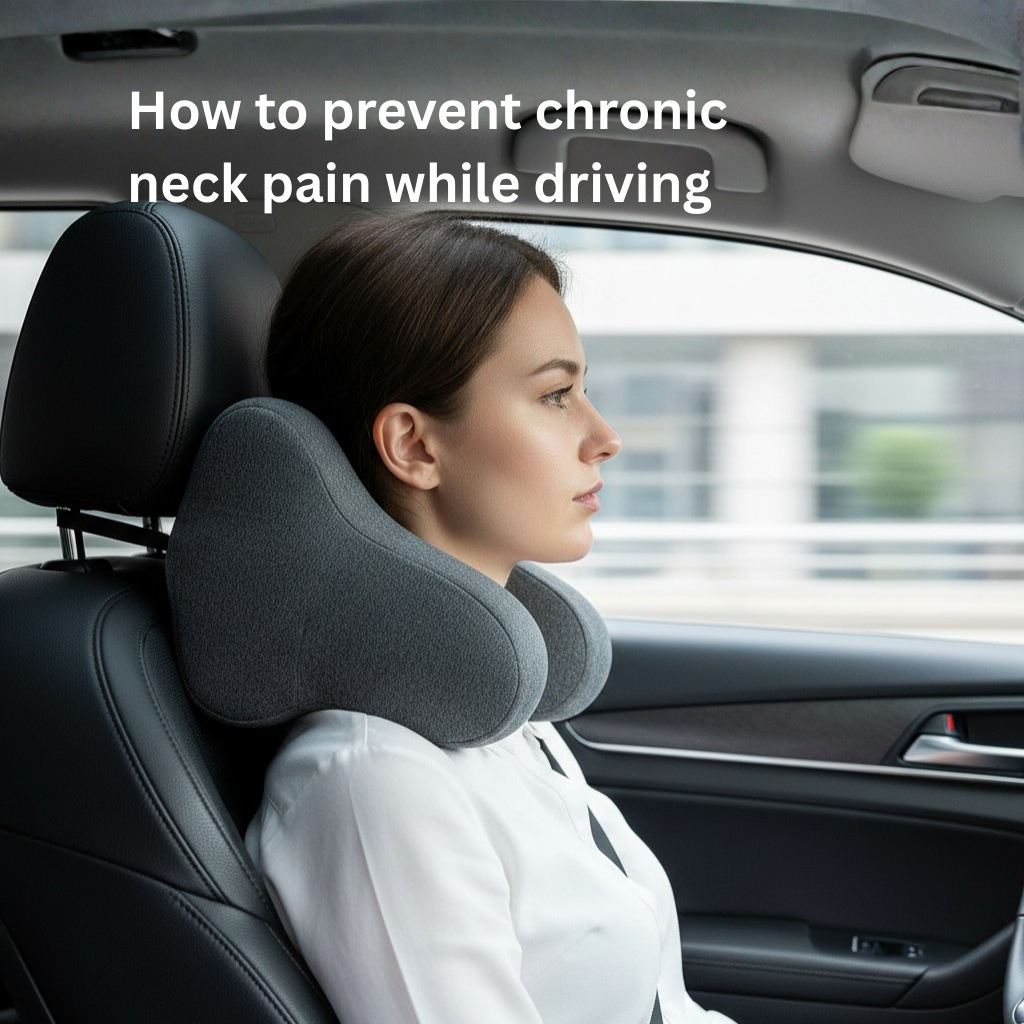
So, how do you stop neck pain when driving? You become the engineer of your own cockpit. Getting the correct seat position to avoid neck strain involves three critical adjustments. This is how to align your spine in a car seat for optimal neck health.
1. The Headrest: Your First Line of Defense, Not a Pillow
Your headrest has one primary job: to prevent whiplash by catching your head during a sudden change in momentum. To do this, it must be positioned correctly. This is the single most important tip for how to adjust headrest for neck support.
- Height: The middle of the headrest should be level with the top of your ears, or the center of the back of your head.
- Distance: Your head should be no more than 2-3 inches from the headrest. Any further, and you give your head too much room to accelerate backward in a collision.
This is where the gender and height gap in vehicle design becomes apparent. Many find the ideal car headrest height and angle difficult to achieve. For shorter drivers, the headrest might be too high even at its lowest setting. For others, an aggressive forward tilt can cause a forward head posture. If this is you, consider a simple modification. Do neck pillows help with neck pain while driving? Bulky, soft pillows often make things worse, but a dedicated cervical pillow for car seat or a small, firm roll strapped to the headrest posts can provide critical cervical spine support without pushing your head forward.
2. The Seat: The Foundation of Your Spine's Health
How you adjust your car seat to prevent neck pain has a cascading effect on your entire body. The goal is to distribute your weight evenly and let the seat carry the load.
- Recline: Avoid sitting bolt upright at 90 degrees. The best seat incline for neck comfort is a slight recline of about 100-110 degrees. This transfers some of your upper body weight to the seatback, taking the load off your spinal muscles.
- Height & Distance: Adjust your seat height so your hips are roughly level with your knees. Move the seat forward or back—adjusting seat distance from pedals for better posture—so you can fully depress the pedals with a slight bend in your knee. If you're stretching, you're creating tension that travels up to your neck.
- Support: Many car seats lack adequate lumbar support, which can cause slouching and subsequent neck strain. This can even contribute to issues like sciatica and neck pain while driving. Using a lumbar roll or a folded towel can help maintain your natural spinal curve. For car seat ergonomics for petite drivers, this is especially important. To make driving more comfortable, you can use a firm seat cushion to raise yourself up in the seat, which can help with vehicle positioning and visibility. Proper positioning impacts the entire kinetic chain. As one of our patients shared, "I was in a car collision and had nonstop knee and leg pain. Shockwave therapy has helped more than anything else..." This demonstrates how forces, whether from a crash or poor ergonomics, affect the whole body. A proper seat position is your first step in managing those forces.
3. Steering Wheel & Mirrors: Minimizing Upper Body Strain
Constant tension in your shoulders and upper back is a direct path to neck pain. Your steering wheel and mirror positions are key to relieving neck tension while commuting.
- Steering Wheel: The proper steering wheel position for shoulder comfort is lower and closer than most people think. You should be able to rest your wrists on top of the wheel with your shoulders against the seatback. Your hands should hold the wheel at 9 and 3 o'clock, with your elbows comfortably bent. This allows you to keep your shoulders relaxed while driving.
- Mirrors: You should be able to see out of your rearview and side mirrors with only a slight movement of your eyes, not by turning your head. Adjust them properly from your ideal driving position to avoid the constant neck twisting that contributes to pain.
Active Countermeasures: In-Car Resets to Combat Commuter Fatigue
Even with a perfectly engineered cockpit, long drives can cause stiffness. You can counteract this with simple, safe exercises for drivers to prevent neck pain, performed right at a stoplight.
- Chin Tucks: This is the best exercise to combat forward head posture. Sit tall and gently pull your chin straight back, as if you're making a double chin. Hold for 3-5 seconds. You'll feel a stretch at the base of your skull.
- Isometric Neck Strengtheners: Place your palm on your forehead and gently press your head forward into your hand without moving. Hold for 5 seconds. Repeat on the back and each side of your head. This activates the stabilizing muscles without straining them.
- Shoulder Blade Squeezes: To fight slouching and relieve pain between the shoulder blades, sit tall and gently squeeze your shoulder blades together. Hold for 5 seconds and release.
These small resets prevent tension from accumulating into chronic pain. It's about addressing the strain before it settles in. We see the power of this proactive approach in our clinic daily. As another client told us, "Shockwave treatment has helped my shoulder pain tremendously! It has allowed me to start playing golf again." His pain, aggravated by driving, was relieved by addressing the deep, accumulated tissue strain—something these exercises help prevent.
Red Flags: When Neck Pain Requires Immediate Attention
While most driving-related neck pain is musculoskeletal, some symptoms can indicate a more serious condition. If you experience what are known as the "5 D's," seek medical attention immediately: Dizziness (vertigo), Diplopia (double vision), Dysarthria (slurred speech), Dysphagia (trouble swallowing), and Drop attacks (sudden collapsing without loss of consciousness). These can be signs of Vertebrobasilar Insufficiency, a serious issue. Furthermore, on a practical safety note, if you are unable to move your head around very easily due to neck pain, you may need to avoid driving.
Making the Right Choice for Your Needs
There is no single "best" solution, only the right one for your situation. Your preference for long-term prevention strategies over short-term pain relief, and whether you focus on your body or your environment, will guide your choice.
- For The Daily Commuter: You experience nagging, persistent neck pain and assume it's "bad posture," but posture exercises offer little relief. Your problem is likely cumulative micro-trauma. Your priority should be Active Environmental Absorption. Spend 15 minutes today re-engineering your cockpit using the 3-point system. This addresses the root cause of the thousands of daily impacts posture correction alone cannot overcome.
- For The Post-Accident Sufferer: You had a minor car accident months ago and still suffer from lingering neck pain that conventional treatments haven't resolved. Your pain is from a major trauma compounded by daily micro-traumas. You need a professional ergonomic assessment for your vehicle setup. Focus on your headrest position and consider physical therapy for driving-related neck issues to address the underlying injury while preventing re-aggravation.
- For The Proactive Professional: You drive frequently for work, feel general stiffness and fatigue, and want to prevent future chronic pain. Your strategy should be a blend of all approaches. Implement the 3-point cockpit setup immediately, but also incorporate the active countermeasure exercises at every long stoplight. Investing in high-quality ergonomic accessories for cars, like an orthopedic car seat cushion, will pay dividends for your long-term health.
Ultimately, understanding the root cause of your pain—whether it’s a single event, poor posture, or the cumulative effect of thousands of micro-traumas—is the key to finding effective, long-lasting relief. At Pure Relief Pain Solutions Chiropractic in Austin, TX, we specialize in advanced diagnostics and holistic therapies to identify the true source of your driving-related pain. We create personalized therapy and ergonomic plans designed not just to treat your pain, but to prevent it from returning. If you're ready to take control of your musculoskeletal health and make your commute a pain-free experience, contact us today to schedule a comprehensive consultation.


Call us today or use our contact form to request an appointment and start getting relief.

