.png)
MRI vs. X-Ray: a clearer look at when you need advanced imaging for an accurate diagnosis


The key to understanding whether you need an X-ray or an MRI is to stop seeing them as competitors and start viewing them as steps in a diagnostic pathway. A quick, foundational X-ray is often the critical first step to rule out obvious issues like fractures, which then guides the decision on whether a more detailed MRI is needed to examine the soft tissues—like ligaments, discs, and nerves—that X-rays cannot see.
The Diagnostic Dilemma: Why 'Which Scan Is Better?' Is the Wrong Question
When you're in pain, clarity is what you crave most. Whether it's a sharp, sudden pain from a sports injury or a chronic ache that's become a part of your daily life, you want answers. In the world of medical diagnostics, imaging tests like X-rays and MRIs are powerful tools for providing those answers. However, patients often find themselves asking, "Which one is better?" or "Why didn't my doctor just order the MRI first?"
This is a completely understandable question, but it’s built on a common misconception. The reality is that choosing the right imaging scan isn't about picking the "best" or most powerful technology right away. Instead, it's about following a logical, efficient, and safe diagnostic path. This journey often begins with a foundational tool to gather initial clues, which then determines if, when, and where a more advanced map is needed. Moving beyond a simple 'vs.' comparison, the key is to see a foundational X-ray not as a lesser alternative to an MRI, but as a critical first step that creates the justification for more advanced imaging.
In this guide, we’ll walk you through that diagnostic pathway. We'll clarify the distinct roles of X-rays, MRIs, and even CT scans, helping you understand the "why" behind your doctor's decisions and empowering you to be a more confident partner in your own healthcare.
The Foundational First Step: Understanding the 'Rule-Out' Power of the X-Ray
Imagine you're trying to solve a puzzle. You wouldn't start by examining every single piece under a microscope; you'd begin by finding the corners and edge pieces to establish a framework. In diagnostic imaging, the X-ray is often that framework. An X-ray, also known as a radiograph, uses a small, controlled amount of ionizing radiation to create a 2D image of the inside of your body. Dense structures, like bones, absorb more of the X-rays and appear white on the image, while softer tissues allow the rays to pass through and appear in shades of gray and black.
This simple mechanism is its greatest strength. X-rays are quick, painless tests primarily used to produce images of bones and can diagnose conditions like bone fractures, arthritis, osteoporosis, and infections. This makes them an incredibly efficient and low-cost "rule-out" tool. For a patient with acute back pain after a fall or intense neck pain after a car accident, a doctor's first clinical question is often, "Is there a fracture?" An X-ray can answer that question in minutes, instantly clarifying the path of care.
What an X-ray Does Best:
- Identifying Fractures: It's the gold standard for diagnosing a broken bone, from a hairline stress fracture to a complex break.
- Assessing Joint Health: An X-ray can clearly show joint space narrowing, bone spurs, and other signs of degenerative conditions like arthritis, making it a key tool for an x-ray for arthritis diagnosis.
- Detecting Bone Abnormalities: It can reveal bone cysts, certain tumors, and infections affecting the bone.
- Evaluating Spinal Alignment: For conditions like scoliosis or assessing general posture, an X-ray provides a clear view of the vertebral column.
However, it's just as important to understand the limitations of x-ray imaging. Because X-rays excel at visualizing dense structures, they provide very little detail about the body's soft tissues. A patient can have a "normal" X-ray and still be in significant pain because the source of the problem—a bulging disc, a torn ligament, or nerve inflammation—is simply invisible to this type of scan.
Charting the Course: How an X-Ray Creates the Roadmap for an MRI
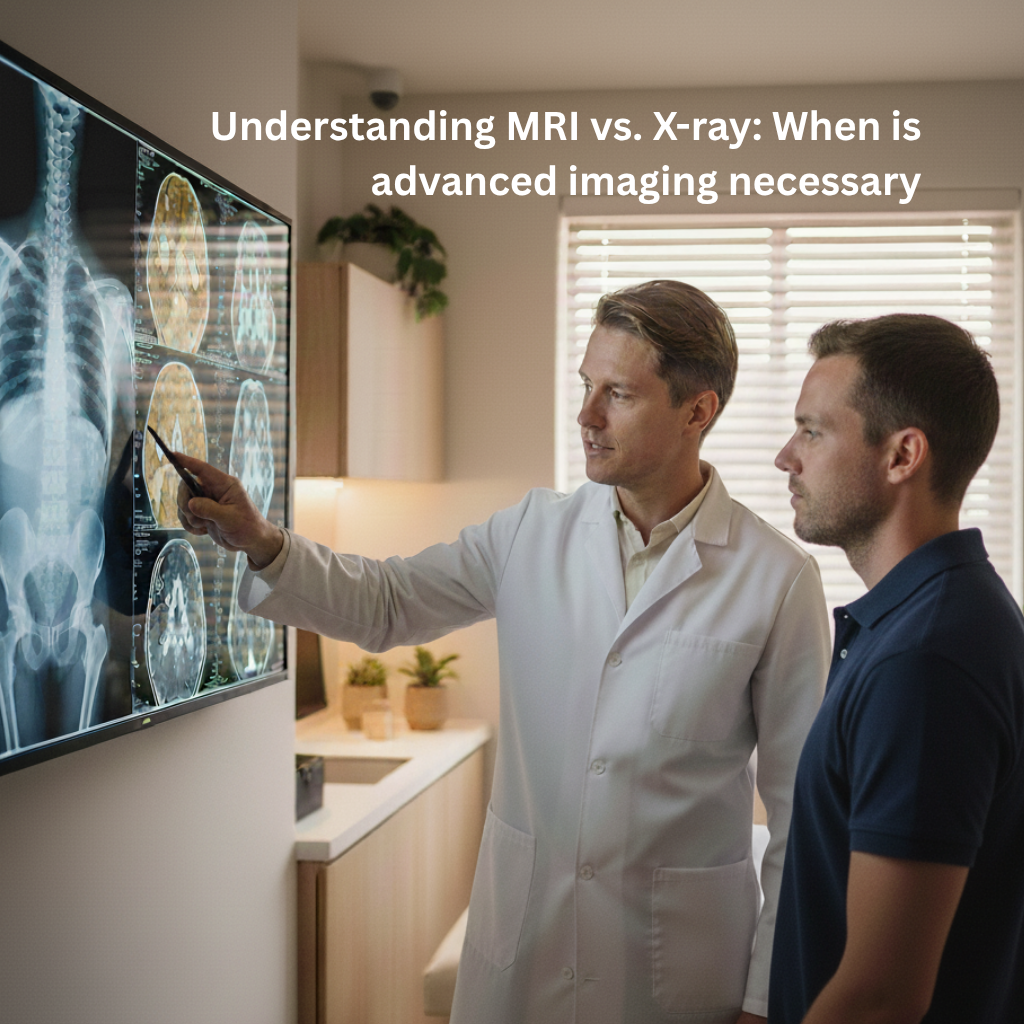
This brings us to one of the most common questions in modern diagnostics: "Why would a doctor order an MRI after X-ray?" The answer lies in the diagnostic pathway. When an X-ray comes back "negative" or "unremarkable" but your symptoms persist, it hasn't failed. On the contrary, it has successfully done its job: it has ruled out an immediate bony cause for your pain. This crucial piece of information now gives your doctor the clear justification to investigate further with a more advanced tool designed to see what the X-ray can't.
Enter Magnetic Resonance Imaging (MRI). An MRI is a marvel of modern medicine. Instead of radiation, it relies on powerful magnetic fields and radio waves to generate images and is non-invasive, unlike X-rays and CT scans which use ionizing radiation. This process excites the water molecules in your body, and a computer interprets the signals they emit to create incredibly detailed, cross-sectional images of your internal structures.
Because different body tissues have different water content, an MRI can distinguish between them with remarkable precision. This is why MRI is considered an 'advanced imaging study' that shows, in fine detail, what’s happening inside soft tissues and is used to diagnose and track tumors, joint problems, and brain injuries.
What can an MRI see that an X-ray cannot?
- Spinal Discs: An MRI of the spine is the best imaging for a herniated disc, showing exactly where it is bulging and if it's pressing on a nerve root.
- Ligaments and Tendons: For knee pain after a sudden twist or persistent shoulder pain, an MRI is the best imaging for a ligament tear (like an ACL) or tendon damage.
- Nerves and the Spinal Cord: An MRI is the only scan that can clearly show nerve compression, inflammation, or damage to the spinal cord itself.
- Muscles: It can detect muscle tears, strains, and other abnormalities within the muscle tissue.
- Brain and Organs: As a diagnostic tool, MRIs are particularly useful in examining the non-bony parts, or soft tissues, inside your body, such as the brain, spinal cord, organs, and muscles.
For many patients suffering from musculoskeletal pain, getting that definitive MRI diagnosis is a turning point. One of our patients who came in for shoulder pain shared, "Shockwave treatment has helped my shoulder pain tremendously! It has allowed to start playing golf again..." This kind of targeted, effective treatment is only possible after a precise diagnosis, which in his case was confirmed with an MRI that identified the specific tendon issue an X-ray couldn't see.
When Urgency Changes the Map: Scenarios That Demand an Immediate Advanced Scan
While the X-ray-then-MRI pathway is the standard for most musculoskeletal and chronic pain conditions, medicine is never a one-size-fits-all discipline. There are specific, urgent "red-flag" scenarios where the nature of the condition is so time-sensitive that doctors must bypass the first step and go directly to advanced diagnostic imaging.
In these high-stakes situations, another powerful tool often enters the picture: the Computed Tomography (CT) scan. What is computed tomography? A CT scan is like a super-powered X-ray. It uses a rotating X-ray machine to take many images from different angles, which a computer then combines to create detailed, cross-sectional "slices" of your bones, blood vessels, and soft tissues. It provides much more detail than a plain X-ray but still uses ionizing radiation—often at a higher dose.
The defining advantage of a CT scan is its speed. While an MRI can take 30 to 90 minutes, a CT scan can be completed in under 10. For this reason, CT scans are significantly faster than MRI, making them the preferred choice in cases of trauma and other acute neurological emergencies where immediate diagnosis is crucial.
When is a CT scan or immediate MRI the right first choice?
- Severe Head Injury: In a trauma situation, a CT scan of the head is used to quickly look for internal bleeding, skull fractures, or brain swelling.
- Suspected Stroke: A CT scan is often the first imaging test performed to determine if a stroke is caused by a bleed or a clot, a critical distinction that dictates immediate treatment.
- Acute Spinal Cord Symptoms: Sudden numbness, weakness, or loss of bowel/bladder control can signal spinal cord compression, which requires an emergency MRI to assess the situation and guide potential surgery.
- Complex Fractures: For severe fractures, especially around a joint, a CT scan provides a 3D view that helps surgeons plan a complex repair.
- Detecting Cancer or Tumors: While an MRI for brain tumors is often the most detailed scan, a CT with contrast dye can be a fast and effective tool for identifying tumors or monitoring their response to treatment.
A Deeper Look: Comparing X-Ray, MRI, and CT Scan Side-by-Side
To help you visualize the roles of these three primary imaging tools, let's break down their pros and cons across the key factors that guide a doctor's decision.
Type of Tissue Being Examined
X-Ray: Primarily for dense tissues. Excellent for bones and detecting changes in bone density. Poor for soft tissues.
MRI: The gold standard for soft tissues. Unmatched detail for ligaments, tendons, spinal discs, nerves, muscles, and the brain.
CT Scan: A versatile middle ground. Provides more detail than an X-ray for both bones and some soft tissues, especially organs and blood vessels (often with contrast dye).
Urgency of the Medical Situation
X-Ray: Very fast (minutes). Ideal for initial assessment in non-emergency clinics and offices.
MRI: Slow (30-90+ minutes). Not suitable for most acute trauma situations where speed is critical.
CT Scan: Extremely fast (5-10 minutes). The go-to imaging for emergency rooms and trauma centers.
Safety Considerations (Use of Ionizing Radiation)
X-Ray: Uses a low dose of ionizing radiation. The risk from a single scan is considered very small.
MRI: Uses no ionizing radiation. It relies on magnets and radio waves, making it the safest option for repeated imaging, children, and pregnant women (after the first trimester).
CT Scan: Uses a higher dose of ionizing radiation than an X-ray. While necessary in many situations, doctors are mindful of the cumulative radiation exposure from repeated CT scans.
Image Detail Required for Diagnosis
X-Ray: Provides a basic, 2D overview. It answers simple, high-contrast questions like "Is the bone broken?"
MRI: Provides the highest level of detail and contrast between different types of soft tissue. It answers complex questions like "Is the ligament torn, and how badly?"
CT Scan: Provides excellent detail in cross-sections, creating 3D-like images. It's superior to X-rays for complex bone structures and better than MRIs for certain acute issues like bleeding.
The Patient Equation: How Your Personal Circumstances Shape the Diagnostic Plan
Beyond the purely clinical factors, your unique situation and personal health profile play a crucial role in tailoring the imaging plan. A good healthcare provider doesn't just treat a symptom; they care for the whole person. This means considering practical and personal details that influence which scan is appropriate for you.
- Insurance Pre-Authorization: One of the most common reasons for the step-by-step approach is insurance. Many health plans require a foundational test like an X-ray to be performed before they will approve coverage for a more expensive advanced imaging study like an MRI. This is to ensure that the costlier test is medically necessary.
- Claustrophobia: The enclosed tube of a traditional MRI machine can be extremely challenging for patients with claustrophobia. The need to lie still for a long period in a tight space can cause significant anxiety. Fortunately, options like an open MRI vs closed MRI can provide a more comfortable experience, though image quality can sometimes be slightly reduced. Discussing your anxiety with your doctor beforehand is key.
- Metal Implants and MRI Safety: Because MRI uses powerful magnets, metal implants and mri safety is a critical consideration. Pacemakers, certain types of aneurysm clips, and other metallic devices can be hazardous. You will be carefully screened for any metal in your body before an MRI. In cases where an MRI is unsafe, a CT scan often becomes the best alternative for detailed imaging.
- ER Urgency vs. Chronic Pain Management: The diagnostic mindset in an emergency room is fundamentally different from that in a clinic managing chronic pain. The ER's goal is to rapidly identify life-threatening conditions. For someone coming in after a major car accident, the speed of a CT scan is paramount. For someone with six months of nagging back pain, the thoughtful, sequential approach of a clinical exam, followed by an X-ray, and then potentially an MRI, is a more appropriate and resource-wise path.
We see this journey often. A patient who came to us after a traffic accident noted, "I was in a car collision and had nonstop knee and leg pain. Shockwave therapy has helped more than anything else..." His story began in the ER with scans to rule out fractures. But his persistent pain required a deeper look weeks later—an MRI that revealed the soft tissue damage that conservative treatments could then effectively target.
Making the Right Choice for Your Needs
So, how do you know if you need an X-ray or MRI? The answer is that you don't have to figure it out alone. The "best" choice is always a collaborative decision made with your healthcare provider based on your specific symptoms, history, and the clinical question that needs to be answered. Here’s how to think about it based on your situation:
For the Recently Injured Patient
If you've had an acute injury from a fall, accident, or sport, your diagnostic journey is focused on immediate assessment. If your doctor orders an X-ray first, be reassured that this is the correct and standard procedure. They are efficiently ruling out the most obvious and urgent problem: a fracture. If that X-ray is clear but your pain and instability continue, you now have a solid clinical reason for the next step. An MRI will be ordered not because the X-ray failed, but because it cleared the way for a more detailed look at the ligaments, cartilage, and tendons that are likely the source of your ongoing symptoms.
For the Chronic Pain Sufferer
Living with long-term pain is exhausting, and it’s easy to feel frustrated if initial tests don't provide answers. If you have chronic back pain, neck pain, or joint pain and your X-ray comes back "normal," try not to view it as a dead end. Instead, see it as valuable information. It tells you and your doctor that the problem isn't likely related to advanced arthritis or a major bone issue. This is the green light to investigate the complex soft tissues. Escalating to an MRI is the logical next step to search for underlying causes like a herniated disc causing nerve pain, a degenerative tendon condition, or subtle cartilage damage that only this advanced imaging can reveal.
For the Proactive Health Researcher
If you are exploring medical technologies to be better informed, the most important takeaway is that imaging is a goal-oriented process. Each tool has a purpose. An X-ray is a wide-angle lens, great for seeing the big picture of the skeleton. A CT scan is like a rapid series of detailed photographs, perfect for emergencies and complex bone views. An MRI is the microscopic lens, offering unparalleled detail of the body's soft, intricate machinery. The safest, most effective, and most cost-conscious approach to diagnostics is to use the simplest tool that can answer the immediate clinical question before moving to more advanced methods.
Ultimately, understanding the diagnostic pathway from X-ray to MRI is about building trust in the process and in your healthcare team. It’s a journey of starting with the most likely questions and progressively narrowing the focus until the true source of your pain is brought into clear view, paving the way for targeted, effective treatment.
Understanding the 'why' behind your diagnostic journey is the first step toward lasting relief. At Pure Relief Pain Solutions Chiropractic, we believe in a clear, collaborative, and patient-centric approach to your care. Our goal is to use precise diagnostic understanding to guide holistic, non-surgical treatments that restore your quality of life. If you're struggling with pain in Austin, TX, and seeking a path to recovery, contact our team to discuss how a precise diagnosis can inform a personalized treatment plan designed just for you.



Call us today or use our contact form to request an appointment and start getting relief.

