.png)
What a modern chiropractor actually does for sciatica


A modern chiropractor helps sciatica not by providing endless adjustments, but by acting as a diagnostic specialist to find the root cause of the sciatic nerve pain. Treatment focuses on short-term relief through targeted manual therapy and advanced techniques, followed by a long-term strategy that empowers patients with exercises and self-care for lasting independence from pain.
That searing, electric pain that shoots from your lower back down your leg can bring your life to a standstill. It’s a sensation familiar to a huge portion of the population; in fact, about 40% of people in the U.S. experience some form of sciatica during their lifetime. When this pain strikes, your first thought is often, "How do I make this stop, now?" For many, the idea of seeing a chiropractor comes to mind, but it's often accompanied by a significant misunderstanding of what that care actually involves.
The common perception involves a quick "crack" of the back and a recommendation to return three times a week indefinitely. This is an outdated and incomplete picture. The truth is, effective chiropractic care for sciatica is a sophisticated, patient-centered process. It's about serving as a diagnostic 'first responder' to identify the precise cause, providing targeted short-term relief, and ultimately, making you the expert in managing your own musculoskeletal health for the long run.
The chiropractor as a diagnostic 'portal of entry' for your pain
Before any treatment begins, the most critical question must be answered: What is actually causing your sciatica? Sciatica isn't a diagnosis in itself; it's a symptom. It describes the pain, numbness, or tingling that results from pressure or irritation of the sciatic nerve. A skilled chiropractor's first job is to play detective.
This is why chiropractors serve as a 'portal of entry' for musculoskeletal issues. You don't need a referral to see one, and they are trained to perform a comprehensive chiropractic evaluation for lower back pain to identify the root cause of your symptoms, according to health experts. A thorough examination for a chiropractor to help sciatica involves:
- Detailed History: Understanding when and how the pain started, what makes it better or worse, and its exact location and sensation.
- Orthopedic and Neurological Tests: Assessing your reflexes, muscle strength, and range of motion to pinpoint the specific nerve root involved. Tests like the straight leg raise help determine the level of nerve irritation.
- Functional Movement Screening: Observing how you walk, bend, and sit to identify biomechanical patterns or muscle imbalances that contribute to the problem.
This process helps us differentiate between the common culprits of sciatic nerve impingement. Is your pain from a bulging disc or herniated disc causing sciatica? Is it spinal stenosis, where the spinal canal narrows? Or is it something like piriformis syndrome, a condition where a muscle deep in your buttock spasms and irritates the sciatic nerve? The chiropractic treatment for piriformis syndrome is vastly different from the approach for a herniated disc. An accurate diagnosis is the bedrock of any successful treatment plan.
Beyond the 'crack': A multi-faceted approach to relief
Once we understand the 'why' behind your pain, the focus shifts to providing relief. While a spinal adjustment is a powerful tool, a holistic chiropractic approach to sciatica uses a combination of techniques tailored to your specific diagnosis. The goal is reducing inflammation in the sciatic nerve and alleviating the pressure causing the irritation.
Manual therapy and advanced technologies
For many patients, especially those with muscular causes like piriformis syndrome, significant relief comes from addressing the soft tissues first. This involves manual release techniques, trigger point therapy, or instrument-assisted methods to relax tight muscles that are compressing the nerve. Many find that this alone can dramatically lower their pain levels without a single spinal adjustment.
We also integrate advanced, non-invasive sciatica treatment options that accelerate healing. For instance, shockwave therapy can be instrumental in breaking up scar tissue and promoting blood flow to an injured area. One of our patients noted, "I was in a car collision and had nonstop knee and leg pain. Shockwave therapy has helped more than anything else..." While his issue was post-traumatic, the principle of using technology to address deep-seated pain and restore function applies directly to complex cases of sciatica from a car accident or chronic conditions.
What does a chiropractic adjustment for sciatica feel like?
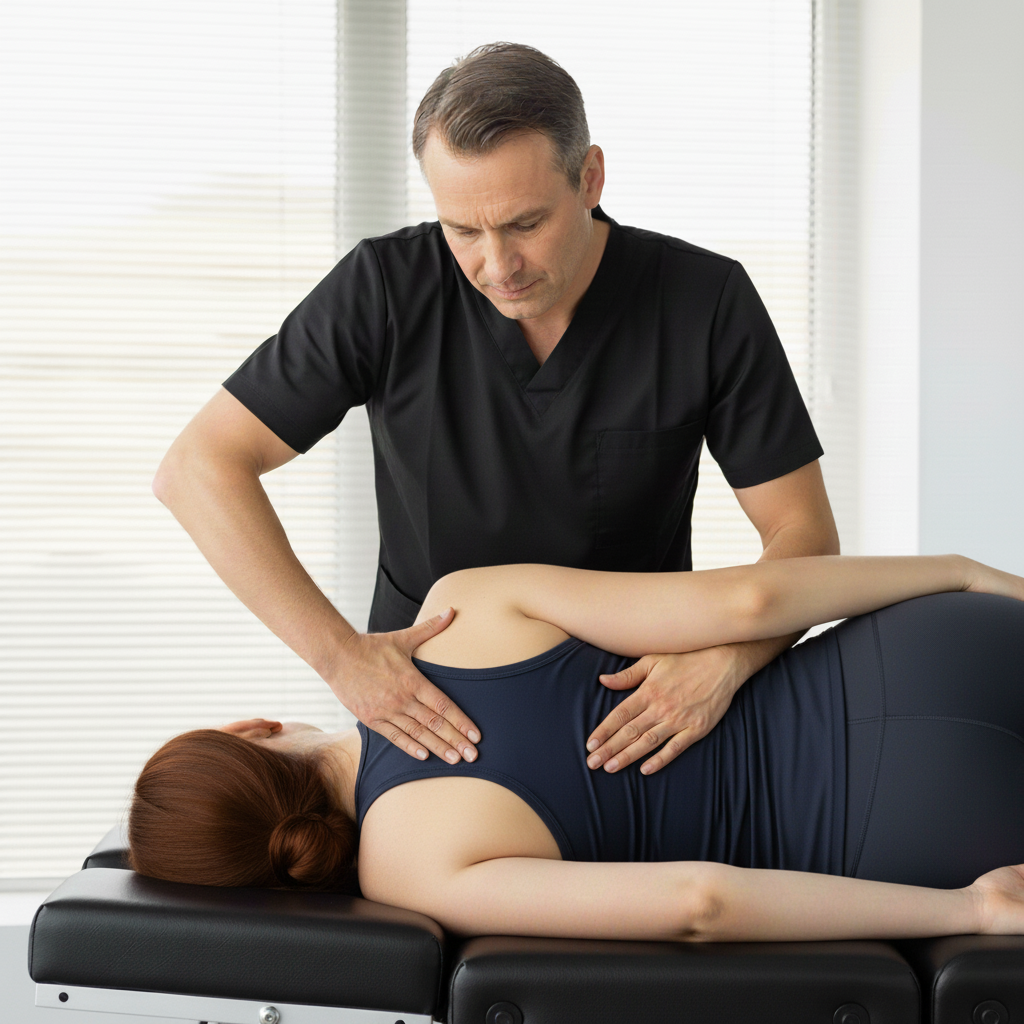
If a spinal joint is truly restricted and contributing to nerve pressure, a chiropractic adjustment for a pinched sciatic nerve is often necessary. A lumbar spine adjustment for sciatica is a gentle, specific, and controlled thrust to a joint to restore its proper motion. Patients typically feel a slight pressure, often followed by an immediate sense of release or increased mobility. For those wary of the traditional "cracking" sound, techniques like the Activator method for sciatic pain use a small, handheld instrument to deliver a precise, low-force impulse to the spine. Other highly effective techniques for disc-related issues include Cox flexion-distraction and spinal decompression therapy for sciatica, which gently stretch the lower back to relieve pressure on the nerve.
The true goal is your independence, not dependence
This is where modern, patient-centered chiropractic care diverges most from outdated models. The objective is not to keep you coming back forever. The objective is to get you better, then give you the tools to stay better on your own.
How many chiropractic sessions for sciatica?
One of the first questions patients ask is, "How fast does chiropractic work for sciatica?" While every case is unique, the initial phase of care is typically short-term. The goal is to see a significant reduction in your symptoms and improvement in function within a few visits, often four or less. This isn't a promise of a complete "fix" in that time, but a benchmark for progress. If you aren't feeling demonstrably better, the treatment plan is re-evaluated.
From day one, the treatment plan transitions toward active patient participation. During treatment sessions, chiropractors often teach patients basic exercises to do at home to prevent symptoms from returning. This is a crucial component of long-term sciatica relief with chiropractic care. You will learn:
- Targeted Stretches: Specific stretches for the piriformis, hamstrings, and lower back muscles to maintain flexibility and reduce tension.
- Core Strengthening Exercises: Simple but effective exercises recommended by chiropractors for sciatica that stabilize your spine and pelvis, creating a natural "corset" of support.
- - Self-Myofascial Release: Techniques using a foam roller or lacrosse ball to manage muscular trigger points and prevent flare-ups.
This emphasis on patient education is fundamental. Our job is to be your health partner and guide, empowering you to take control of your chiropractic and musculoskeletal health for sciatica.
Comparing your sciatica care options
When you're in pain, you have choices. It's important to understand the philosophy and approach behind each one. This is especially true when comparing a chiropractor vs a physical therapist for sciatica or considering medication.
Focus on Long-Term Prevention vs. Only Short-Term Relief

Repetitive Adjustment-Based Care
Approach: Primarily uses spinal adjustments to provide temporary relief. Treatment plans can be lengthy and passive, fostering patient dependency.
Pros: Can provide immediate, short-term relief for some patients.
Cons: Often fails to address underlying muscular imbalances or instability, leading to recurring symptoms. The focus is on ongoing treatment rather than patient empowerment.
Diagnostic and Rehabilitative Care (Our Approach)
Approach: Combines accurate diagnosis with a mix of manual therapy, adjustments (if necessary), and a strong emphasis on rehabilitative exercise and patient education.
Pros: Aims to solve the root cause of the problem for lasting results. Empowers the patient with self-care strategies, reducing the need for future care.
Cons: Requires active participation from the patient; results are dependent on you doing the at-home care.
Pharmacological/Surgical Interventions
Approach: Uses NSAIDs, muscle relaxants, nerve pain medications, epidural steroid injections, or surgery to manage symptoms or address structural issues.
Pros: Can be very effective for managing severe, acute pain and is necessary for certain conditions like cauda equina syndrome or progressive neurological deficits.
Cons: Medications can have side effects and mask the underlying problem. Surgery is invasive, carries risks, and is typically a last resort.
Official medical guidelines often align with the diagnostic and rehabilitative model. A 2017 analysis found that spinal manipulation provides modest improvement in acute low-back pain, similar to NSAIDs, but without the potential side effects, according to the NCCIH. This supports using manual therapy as a first-line defense before resorting to medication. Furthermore, a randomized clinical trial demonstrated the effectiveness of spinal manipulation for acute back pain and sciatica with disc protrusion, cementing its role as a valid medical intervention.
Answering a common concern: Can a chiropractor make sciatica worse?
This is a valid question. The answer lies in the quality of the initial diagnosis. If a chiropractor applies a forceful adjustment to an acutely inflamed disc herniation without a proper evaluation, it could potentially worsen the symptoms. This is why our process starts with a thorough, careful assessment. A skilled, diagnostically-driven chiropractor knows when to adjust, what techniques to use (like gentle flexion-distraction), and, just as importantly, when not to adjust. Is it safe to see a chiropractor for sciatica? Yes, when you are under the care of a professional who prioritizes a precise diagnosis before any treatment.
Can sciatic nerve pain cause nausea?
Yes, it's possible. While not a primary symptom, severe, intense pain of any kind can trigger a systemic response from your body. This is part of the autonomic nervous system's reaction to intense stimuli. The pain signals traveling up the spine can overwhelm the central nervous system, leading to secondary symptoms like nausea, sweating, or lightheadedness. If you experience nausea with your sciatica, it's a sign that the pain is severe and you should seek a professional evaluation immediately.
Making the right choice for your needs
So, is it good to see a chiropractor for sciatica? The answer depends on the chiropractor's approach and your individual needs. The most successful treatment for sciatica pain is one that correctly identifies the cause and addresses it with a comprehensive, patient-focused plan. Here’s how to decide what's right for you.
The Acute Sufferer
You've experienced a sudden onset of debilitating sciatic pain. Your goal is finding immediate relief for sciatica. Look for a provider who prioritizes a rapid but thorough diagnosis to rule out red flags and can offer gentle, targeted therapies to reduce inflammation and pressure quickly. The focus should be on calming the nerve and restoring basic function as a first step.
The Chronic Patient
You've been dealing with recurring sciatica flare-ups for months or years. You may have tried other treatments without lasting success. You need a partner who will dig deeper to find the root cause—the weak core, the chronic muscle imbalance, the hidden joint dysfunction—that other approaches have missed. Your ideal plan will have a heavy emphasis on rehabilitation and strengthening to build resilience against future episodes.
The Cautious Investigator
You're wary of chiropractic care, perhaps due to past experiences or stories you've heard. You need evidence of a modern, scientific approach. Seek a chiropractor who clearly explains their diagnostic process, provides a finite treatment plan with clear goals and a timeline, and whose ultimate objective is to teach you how to manage your condition independently.
Ultimately, a modern approach to chiropractic for lower back and leg pain is about precision, partnership, and empowerment. It’s a sciatica pain relief specialist that serves as your first point of contact to accurately diagnose your condition, provide effective non-surgical treatment, and guide you on a path to lasting wellness and independence from pain.
At Pure Relief Pain Solutions Chiropractic in Austin, TX, we are committed to this diagnostic-first, patient-empowerment model. Our goal is to provide a clear path to recovery that combines advanced technology with a deep understanding of biomechanics. If you are struggling with sciatica and are ready for a different approach that prioritizes long-term solutions, contact our expert team today for a comprehensive evaluation.


Call us today or use our contact form to request an appointment and start getting relief.

